
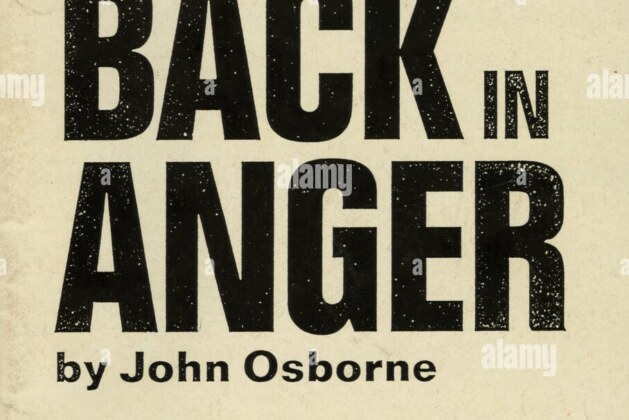
Look Back in Anger, first performed on 8 May 1956 at the Royal Court Theatre in London, is widely regarded as the play that changed British theatre forever. Before 1956, the West End was dominated by light comedies, murder mysteries, and well-made plays by writers like Terence Rattigan and Noël Coward.
John Osborne’s play exploded onto the stage with raw language, domestic violence, class hatred, and a screaming, jazz-trumpet-playing anti-hero who refused to be polite. Critics immediately labelled its main character and people like him “Angry Young Men,” and the phrase entered the language.
The play is set in the mid-1950s in a cramped, shabby one-room flat in the Midlands. Britain was still recovering from World War II: rationing had only just ended in 1954, the old class system was cracking but still powerful, and many educated young people from working-class or lower-middle-class backgrounds felt betrayed by a country that had promised them a better life after the war but delivered boredom, snobbery, and dead-end jobs instead. Jimmy Porter is the voice of that frustration.
Characters
- Jimmy Porter (mid-20s): Intelligent, university-educated, runs a sweet-stall in the market. Bitter, sarcastic, cruel, and desperately passionate. Hates almost everything: the upper classes, the Church, the press, complacency, and especially people who refuse to feel anything deeply.
- Alison Porter (mid-20s): Jimmy’s wife. Comes from an upper-middle-class family with colonial and military background. Quiet, ironing endlessly, pregnant (though she hides it for most of the play), emotionally numb as a defence against Jimmy’s verbal assaults.
- Cliff Lewis (mid-20s): Jimmy’s best friend and business partner. Warm, Welsh, uneducated but kind-hearted. Acts as a buffer between Jimmy and Alison.
- Helena Charles (early 30s): Alison’s friend, an actress. Middle-class, attractive, self-assured, and initially disapproving of Jimmy. Becomes his lover in Act III.
- Colonel Redfern (60s): Alison’s father. Retired Indian Army officer. Gentle, bewildered by the modern world, feels vaguely guilty about the British Empire and about his daughter’s unhappy marriage.
Detailed Scene-by-Scene Summary
Act I (A Sunday afternoon in the Porters’ flat)
The play opens with Jimmy and Cliff reading the Sunday newspapers while Alison stands at the ironing board. The flat is small, cluttered, and ugly. Jimmy is already in a rage because the newspapers are “ignorant, gutless, and dull.” He attacks the Bishop of Bromley, Alison’s family, the government – everything. His language is a mixture of university-level vocabulary and market-stall vulgarity.
Cliff and Jimmy playfully wrestle; Jimmy is affectionate with Cliff in a way he never is with Alison. Alison remains silent, ironing. Jimmy keeps provoking her, calling her “Lady Pusillanimous” and mocking her upper-class background. He says her family fought to protect “the right to be stupid.”
We learn that Jimmy’s father died when he was a child after being wounded in the Spanish Civil War (fighting against Franco). Jimmy watched him die slowly and painfully, and this memory fuels his hatred of indifference.
Helena Charles is coming to stay for a few days. Jimmy hates her in advance because she is Alison’s posh actress friend. When Helena’s telegram arrives, Jimmy launches into another tirade.
Alison finally reveals to Cliff (when Jimmy is out of the room) that she is pregnant, but she has not told Jimmy because she is terrified of his reaction.
Jimmy returns and senses something is wrong. He cruelly wishes aloud that Alison could have a child that died so she would know what real suffering feels like. Alison accidentally burns her arm with the iron. Jimmy storms out to play his trumpet. Helena arrives.
Act II Scene 1 (Two weeks later – another Sunday afternoon)
Helena has been staying for a fortnight. She and Alison have sent for Colonel Redfern to take Alison home. Helena now openly disapproves of Jimmy and thinks Alison should leave him.
Jimmy continues his verbal assaults. He calls Helena “Saint Helena” and mocks her middle-class morality. He sings vulgar music-hall songs and plays his trumpet loudly.
Alison tells Helena the story of how she and Jimmy met: she was a university friend of his first girlfriend, and Jimmy pursued her out of class revenge. Their wedding was a disaster – her parents opposed it, and Jimmy’s working-class friends were hostile.
Jimmy leaves to visit the mother of an old friend, Mrs Tanner, who is dying. Before he goes, he tells Alison and Helena that if Mrs Tanner dies, “someone will have to pay.”
Alison confesses to Helena that she is pregnant. Helena is shocked and insists Alison must tell Jimmy immediately and then leave him.
Jimmy returns, angry and drunk. He senses the atmosphere has changed. Helena tells him she has telephoned Alison’s father. Jimmy explodes, calling Helena a “bitch” and an “evil-minded little virgin.” He wishes Alison would miscarry so she could feel real pain.
Alison slaps Helena for interfering. Jimmy storms out again.
Act II Scene 2 (The next day – Monday evening)
Colonel Redfern has arrived with a car to take Alison away. He is gentle, old-fashioned, and confused by the hatred his daughter’s marriage has produced. He admits that he and his wife never understood Alison’s choice of Jimmy.
Alison tells her father she is leaving Jimmy. She puts on her old raincoat and squirrel-fur coat as symbols of returning to her old life.
Jimmy returns just as Alison is leaving. He is sarcastic and cruel again, calling her “the Lady of the Manor going home.” Alison leaves without telling him she is pregnant.
Helena stays behind to tell Jimmy that Alison has gone for good. Jimmy is vicious to her, but Helena suddenly kisses him passionately. They fall into each other’s arms.
Act III Scene 1 (Several months later – another Sunday afternoon)
The flat looks cleaner. Helena is now living with Jimmy and doing the ironing – exactly what Alison used to do. Jimmy and Cliff are reading the papers again. The situation looks almost identical to Act I, except Helena has replaced Alison.
Jimmy is still angry, but now he directs his rage at Helena’s middle-class friends and the theatre world. Helena is more able to fight back than Alison was.
Cliff announces that he is leaving the sweet-stall and the flat to live on his own. He feels he has been used as a buffer for too long.
Helena suddenly realises she has become exactly what she hated – the woman living in misery with Jimmy. She decides she cannot stay. She telephones Alison (who has lost the baby through miscarriage) and tells her to come back.
Jimmy is devastated when Helena says she is leaving. For once he is almost gentle. Helena leaves.
Act III Scene 2 (Later the same evening)
Alison returns, pale and broken. She tells Jimmy she has lost their baby. For the first time in the play, Jimmy is tender. He kneels at her feet.
They return to their private fantasy game of “bears and squirrels” – a childish world where they can escape pain. Alison says she is now as empty and lost as Jimmy always was. The play ends with them clinging to each other in the dark, playing their game again.
Jimmy: “Don’t let’s bicker and be nasty to each other any more.” Alison: “Poor bears… poor squirrels…”
Major Themes
- Class War The central conflict is class hatred. Jimmy loathes the upper-middle-class world Alison comes from – the colonels, the bishops, the complacent establishment that sent working-class boys to die in wars while protecting their own privileges.
- The Death of Passion Jimmy screams that nobody feels anything anymore. He wants “a little ordinary human enthusiasm.” His cruelty is partly an attempt to force people to feel something – even if it is pain.
- Gender and Power Jimmy is both misogynistic and dependent on women. He needs Alison (and later Helena) as a punching bag for his rage, yet he cannot live without them.
- Loss and Childishness The “bears and squirrels” game is both pathetic and touching – two damaged adults retreating into a private childhood because the real world is too painful.
- Post-War Disillusionment Jimmy fought for nothing. The promised brave new world never arrived. The welfare state exists, but it feels cold and bureaucratic.
Why the Play Was Revolutionary
- Language: Characters swear, use working-class slang, and speak in long, passionate monologues.
- Subject matter: Domestic violence, class hatred, sexual frustration – all shown on stage.
- Anti-hero: Jimmy is cruel, selfish, and often unlikeable, yet the audience is forced to understand his pain.
- Kitchen-sink realism: The ironing board, the gas stove, the Sunday papers – ordinary life in all its ugliness.
Legacy
Look Back in Anger started the “Angry Young Men” movement (Osborne, Arnold Wesker, John Braine, Alan Sillitoe, etc.). It made the Royal Court Theatre the home of new writing. It changed acting styles – Richard Burton, Kenneth Haigh, Albert Finney, and later Tom Courtenay all played Jimmy. It influenced film, television, and music (The Beatles, The Who, and many others cite it as an influence).
The phrase “angry young man” is still used today to describe any rebellious, articulate young person who feels cheated by society.
Look Back in Anger is not a comfortable play. Jimmy Porter is not a hero. But it remains powerful because it captures a moment when an entire generation woke up and realised that the old rules no longer worked, and nobody had written new ones yet. In its pain, its cruelty, and its strange tenderness, it is one of the defining works of 20th-century British theatre.
Leave a comment