
WAEC Agricultural Science Answers 2026
OBJ
01-10: DBCBDCCDCB
11-20: ADDABDCADC
21-30: ACCCDBCACB
31-40: DCDDCBBACB
41-50: DCCABCCABC
COMPLETED✅ ✅
NUMBER 1
(1ai)
=Rural-urban migration=
(I) It Reduces number of young farm workers
(ii) It Increases age of farmers (mostly old people left)
(iii) It Leads to farmlands being abandoned
(1aii) Inadequate farm inputs (e.g., seeds, fertilizer)
(I) Low crop yields
(ii) Poor soil fertility
(iii) Increased pest and disease damage
(1aiii) Inadequate storage facilities
(I) High post-harvest losses (rot, pests)
(ii) Forced selling at low prices immediately after harvest
(iii) Reduced food availability in off-season
(1b)
Farm tools are Simple hand-operated equipment (e.g., cutlass, hoe) while Farm machinery: Complex, engine-powered equipment (e.g., tractor, harvester)
(1c)
(I) It is used for Clearing bushes and trees for new farmland
(ii) It is used for Levelling and grading land
(iii) It is used for Digging ponds or ditches
(iv) It’s used for Removing stumps and rocks
(1d)
(I) Spanners (wrenches)
(ii) Grease gun
(iii) Screwdrivers
NUMBER 2
(2a)
(i) Horizon A is the topsoil layer of the soil profile. It is dark in colour, rich in humus and plant nutrients, contains many microorganisms, and supports most plant roots.
(2a)
(ii) Horizon B is the subsoil layer found below Horizon A. It contains less organic matter but is rich in minerals leached from the topsoil and is usually more compact.
(2a)
(iii) Horizon C is the weathered parent material layer. It consists of partially broken rock fragments with little organic matter and few living organisms.
(2a)
(iv) Horizon D is the bedrock or parent rock layer. It is the solid, unweathered rock from which the soil is formed.
(2b)
Sedimentary Rock
(i) Limestone
(ii) Dolomite
(iii) Coal
Metamorphic Rock
(i) Marble
(ii) Slate
Igneous Rock
(i) Gabbro
(2c)
(i) It affects the rate of seed germination.
(ii) It influences the rate of plant growth and development.
(iii) It affects flowering, fruiting, and crop yield.
(iv) It influences the distribution and productivity of livestock.
NUMBER 3
(3a)
(i) Alley cropping
It a type of farming which involves growing food crops between rows of trees or shrubs. When trees are pruned, leaves add nutrients to the soil.
(ii) Ley farming
It is a type of farming that involves growing grasses or legumes for a few years after food crops, then ploughing them into the soil to restore fertility.
(iii) Taungya system
This type of farming where Farmers grow food crops among young forest trees until the trees grow big, then move to a new area.
(3b)
(I) Improves soil fertility (trees add organic matter)
(ii) Provides firewood and timber from same land
(iii) Controls soil erosion
(iv) Gives shade for some crops
(v) Increases total farm output per land area
(3c)
(i) Water cycle description
Water from rivers, lakes, and land evaporates into the air (evaporation). Plants release water vapour (transpiration). Vapour rises, cools, forms clouds (condensation), then falls as rain (precipitation), and flows back to water bodies.
(3cii)
(I) Capillary water (held between soil particles, available to plants)
(ii) Gravitational water (drains down with gravity)
(3d) Cultivation of ginger:
(i) Soil requirement
Loamy soil that is loose, well-drained, and rich in organic matter. Not waterlogged.
(ii) Land preparation
Clear land, plough deeply, harrow to make soil fine, dig ridges or raised beds for good drainage
NUMBER 4
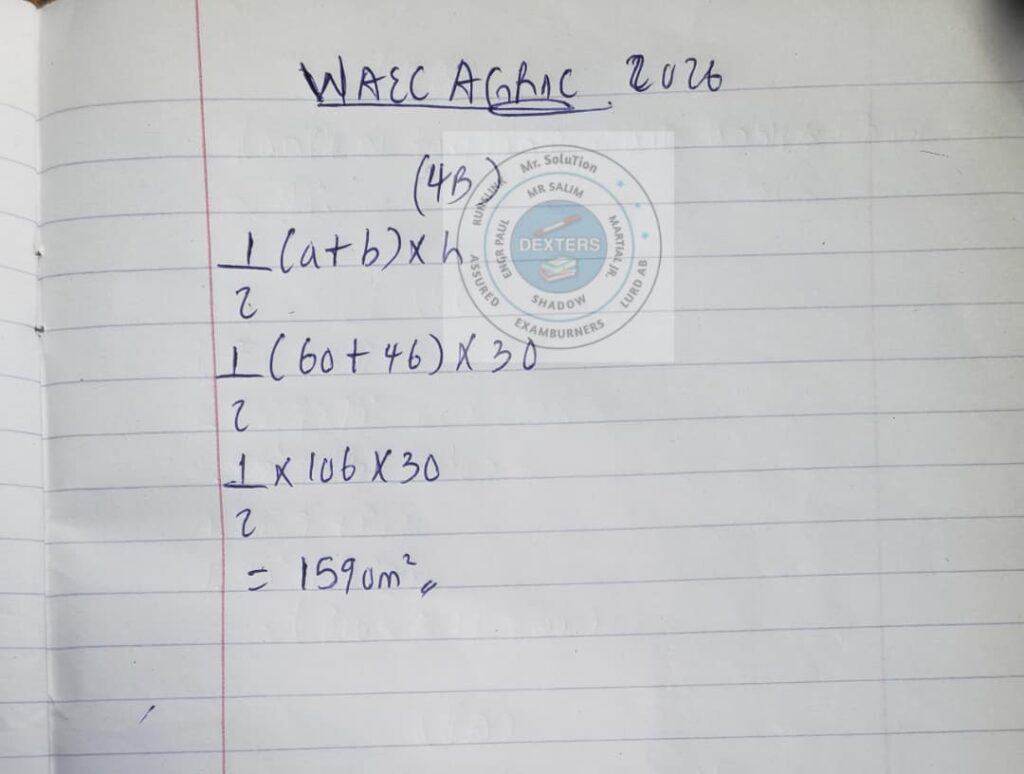
NUMBER 5
(5ai)
(PICK FOUR ONLY)
(i) Sorting the oranges.
(ii) Grading according to size and quality.
(iii) Packaging the oranges properly.
(iv) Storing the oranges in suitable storage facilities.
(v) Processing the oranges into juice or concentrates.
(vi) Transporting the oranges to distribution centres.
(5aii)
(PICK FIVE ONLY)
(i) Provision of good road networks.
(ii) Provision of storage and cold-room facilities.
(iii) Granting loans to farmers and marketers.
(iv) Establishment of marketing boards.
(v) Provision of transport facilities.
(vi) Encouraging export of oranges.
(vii) Providing market information services.
(viii) Reducing taxes and levies on agricultural produce.
(5b)
(PICK FIVE ONLY)
(i) Inadequate number of extension officers.
(ii) Poor road network to rural areas.
(iii) Lack of transport facilities.
(iv) Insufficient government funding.
(v) Large area of coverage assigned to extension officers.
(vi) Poor communication facilities.
(vii) Insecurity in some rural communities.
(viii) Poor motivation and remuneration of extension officers.
(5ci)
Taenia saginata
(5cii)
Taenia solium
(5d)
(PICK ANY TWO)
(i) Regular deworming of farm animals.
(ii) Proper disposal of animal and human faeces.
(iii) Maintaining good farm sanitation.
(iv) Provision of clean feed and water.
(v) Proper meat inspection before consumption.
COMPLETED ✅
Agricultural Science is the branch of science that deals with the cultivation of crops, rearing of animals, processing of agricultural products, and the management of natural resources for the benefit of humanity. It is one of the oldest occupations in the world and serves as the foundation of food production. Agriculture provides food, raw materials for industries, employment opportunities, and income for individuals and governments. The study of Agricultural Science helps students understand the principles and practices involved in producing crops and animals efficiently and sustainably.
Agriculture is essential for human survival because it supplies the food needed for growth, health, and development. Before the development of modern agriculture, people depended mainly on hunting and gathering for food. As human populations increased, agriculture became necessary to provide a steady supply of food. Today, agriculture remains a major sector of the economy in many countries and contributes significantly to national development.
Agricultural Science can be divided into several branches. These include crop production, animal production, soil science, agricultural engineering, agricultural economics, agricultural extension, forestry, fisheries, and horticulture. Each branch focuses on a specific aspect of agricultural production and development. Together, these branches help improve food production and ensure the efficient use of resources.
One of the most important aspects of agriculture is soil. Soil is the natural medium in which plants grow. It provides physical support, water, air, and nutrients necessary for plant growth. Soil is formed through the weathering of rocks over a long period of time. Weathering may occur through physical, chemical, or biological processes. The quality of soil greatly influences agricultural productivity because healthy soil supports healthy plant growth.
Soil is composed of mineral particles, organic matter, water, and air. The mineral particles originate from weathered rocks, while organic matter comes from decomposed plants and animals. Soil water supplies moisture to plants, and soil air provides oxygen needed for root respiration. The balance among these components determines the fertility and productivity of the soil.
Different types of soil exist, and each has unique characteristics. Sandy soil contains large particles and allows water to drain quickly. Although it is easy to cultivate, it may not retain enough water and nutrients for crops. Clay soil contains very fine particles and retains water effectively, but it may become waterlogged and difficult to work with. Loamy soil contains a balanced mixture of sand, clay, and organic matter. It is generally regarded as the best soil for agriculture because it possesses good drainage, adequate moisture retention, and high fertility.
Soil fertility refers to the ability of soil to provide nutrients required for plant growth. Plants require essential nutrients such as nitrogen, phosphorus, potassium, calcium, magnesium, and sulfur. When these nutrients are lacking, crop growth becomes poor, and yields decrease. Farmers maintain soil fertility through the application of fertilizers, manure, compost, crop rotation, and other soil management practices. Proper soil management ensures continuous agricultural productivity and prevents land degradation.
Crop production involves the cultivation of plants for food, fiber, medicine, and industrial use. Crops are classified into different groups based on their uses. Food crops are grown primarily for human consumption. Examples include maize, rice, yam, cassava, millet, and beans. Cash crops are cultivated mainly for sale and industrial purposes. Examples include cocoa, cotton, rubber, coffee, and oil palm. Vegetable crops such as tomatoes, onions, and peppers are important sources of vitamins and minerals.
Successful crop production requires several farming operations. Land preparation is the first stage and involves clearing vegetation, removing obstacles, and preparing the soil for planting. Proper land preparation improves soil conditions and promotes healthy crop establishment. After land preparation, seeds or planting materials are introduced into the soil. The success of planting depends on factors such as seed quality, planting depth, spacing, and environmental conditions.
After planting, crops require continuous care. Weeding is necessary to remove unwanted plants that compete with crops for nutrients, water, sunlight, and space. Fertilizer application helps provide essential nutrients required for growth. Irrigation may be used where rainfall is inadequate to ensure that crops receive sufficient water. Farmers also protect crops from pests and diseases through proper management practices.
Pests are organisms that damage crops and reduce agricultural productivity. Common crop pests include insects, rodents, birds, and nematodes. These pests feed on crops and may destroy large portions of farm produce if not controlled. Crop diseases are caused by pathogens such as fungi, bacteria, viruses, and parasites. Diseases can affect plant growth, reduce yields, and lower the quality of agricultural products. Farmers use various methods to control pests and diseases, including chemical, biological, cultural, and mechanical methods.
Agricultural Science also involves animal production. Animal production refers to the rearing and management of farm animals for food, labor, and income. Farm animals provide meat, milk, eggs, hides, skins, manure, and other valuable products. Common farm animals include cattle, goats, sheep, pigs, poultry, rabbits, and fish. Livestock production contributes significantly to food security and economic development.
The management of farm animals requires proper feeding, housing, healthcare, and breeding. Animals need balanced diets containing carbohydrates, proteins, fats, vitamins, minerals, and water to grow and remain healthy. Proper housing protects animals from harsh weather conditions, predators, and diseases. Farmers also provide veterinary care to prevent and treat illnesses. Good management practices improve productivity and ensure the welfare of animals.
Animal breeding is the process of selecting and mating animals to improve desirable characteristics such as growth rate, disease resistance, milk production, and meat quality. Through breeding, farmers can develop superior animal breeds that perform better under specific environmental conditions. Breeding plays an important role in increasing livestock productivity and meeting the growing demand for animal products.
Fisheries is another branch of Agricultural Science concerned with the production and management of fish and other aquatic organisms. Fish is an important source of protein and contributes significantly to human nutrition. Fisheries may involve the capture of fish from natural water bodies or the cultivation of fish in ponds, tanks, and cages. Fish farming, also known as aquaculture, has become increasingly important in meeting the demand for fish products.
Forestry deals with the establishment, management, and conservation of forests. Forests provide timber, fuelwood, medicinal plants, wildlife habitats, and environmental protection. Trees help prevent soil erosion, regulate climate, improve air quality, and conserve biodiversity. Sustainable forest management ensures that forest resources remain available for future generations while protecting the environment.
Agricultural engineering applies engineering principles to agricultural production. It involves the design, construction, and maintenance of farm structures, irrigation systems, machinery, and equipment. Agricultural machines such as tractors, ploughs, harvesters, and planters increase efficiency and reduce the amount of labor required for farming activities. Mechanization has greatly improved agricultural productivity in many parts of the world.
Agricultural economics focuses on the financial and business aspects of agriculture. It examines the production, distribution, marketing, and consumption of agricultural products. Farmers must make decisions regarding resource allocation, investment, pricing, and marketing to maximize profits. Agricultural economics helps improve decision-making and contributes to the efficient management of agricultural enterprises.
Agricultural extension involves the transfer of agricultural knowledge and innovations from research institutions to farmers. Extension officers educate farmers on improved farming techniques, modern technologies, pest control methods, and efficient resource management. Through agricultural extension services, farmers gain access to information that helps improve productivity and income.
Agriculture faces several challenges that affect production and sustainability. These challenges include inadequate financing, poor transportation systems, climate change, soil degradation, pest infestations, diseases, inadequate storage facilities, and limited access to modern technology. Addressing these challenges requires government support, research, education, infrastructure development, and the adoption of modern agricultural practices.
Modern agriculture emphasizes sustainable practices that protect the environment while maintaining productivity. Sustainable agriculture involves the careful use of natural resources to ensure that future generations can also benefit from them. Practices such as crop rotation, organic farming, conservation tillage, agroforestry, and efficient water management help maintain environmental balance and agricultural productivity.
Agriculture plays a crucial role in national development. It provides food for the population, raw materials for industries, employment opportunities for millions of people, and foreign exchange earnings through exports. It also contributes to poverty reduction and rural development. A strong agricultural sector promotes food security and economic stability.
In conclusion, Agricultural Science is the study of crop production, animal husbandry, soil management, fisheries, forestry, and other agricultural activities. It provides the knowledge and skills necessary for efficient food production and resource management. Agriculture remains one of the most important sectors of the economy because it supplies food, creates employment, supports industries, and contributes to national development. A sound understanding of Agricultural Science enables students to appreciate the importance of agriculture and prepares them to contribute to sustainable agricultural growth and food security in the future.


Leave a comment