
WAEC Government Answers 2026
WAEC Government OBJ
01-10: ACDBDABBAB
11-20: DBABDABDAD
21-30: BBAACBAABC
31-40: BBCCACBDCC
41-50: BDABDAADDC
Number 1
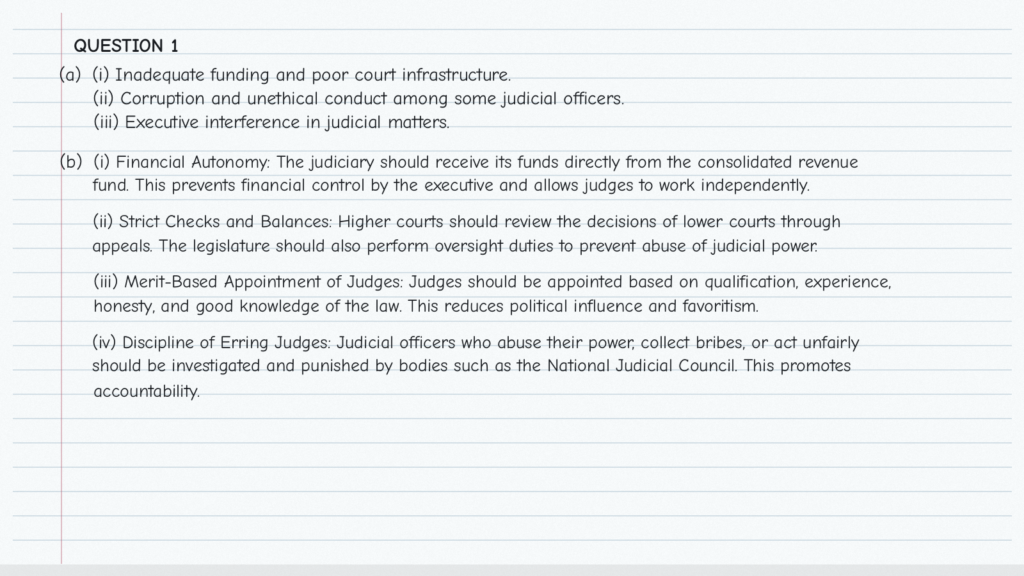
(1a)
(PICK ANY THREE)
(i) Inadequate funding and poor infrastructure.
(ii) Corruption and unethical conduct among some judicial officers.
(iii) Delay in the hearing and determination of cases.
(iv) Executive interference in judicial matters.
(v) Shortage of qualified judges and court workers.
(vi) High cost of seeking justice in court.
(1b)
(PICK ANY FOUR)
(i) Strict Adherence to the Constitution
Judicial autocracy can be prevented when judges and courts operate strictly according to the constitution. The constitution should remain the highest law of the country, and no judge should be allowed to act above it. When court decisions are guided by constitutional provisions, judges will not use their powers carelessly or unfairly.
(ii) Right of Appeal to Higher Courts
The existence of higher courts helps to check the abuse of judicial power. If a lower court gives a wrong or unfair judgment, the affected person can appeal to a higher court. This makes judges careful because they know that their decisions can be reviewed and corrected by a superior court.
(iii) Independence of the Judiciary with Accountability
The judiciary should be independent from the control of the executive and legislature, but judges must also be accountable. This means that judges should be free to decide cases without fear or favour, but any judge who acts wrongly, collects bribe, or misuses power should be investigated and punished through the proper legal process.
(iv) Proper Appointment of Judges
Judges should be appointed based on merit, experience, honesty, and good knowledge of the law. Political favouritism should be avoided in the appointment of judicial officers. When only qualified and disciplined people are appointed as judges, the chances of judicial autocracy will be reduced.
(v) Removal or Discipline of Bad Judges
There should be a legal way of removing or disciplining judges who abuse their office. Bodies like the National Judicial Council should investigate complaints against judges and recommend punishment where necessary. This will stop judges from behaving as if they are above the law.
(vi) Public Trial and Free Press
Court proceedings should be open to the public except in special cases allowed by law. The press should also be free to report court activities fairly. When the public can observe what happens in court, judges will be more careful and less likely to misuse their power.
(vii) Respect for the Rule of Law
Judicial autocracy can be prevented when everyone, including judges, leaders, and citizens, respects the rule of law. Judges should not make decisions based on personal interest, friendship, tribe, religion, or political pressure. They should decide cases only according to the law and the evidence before them.
ANOTHER TYPE
NUMBER 2
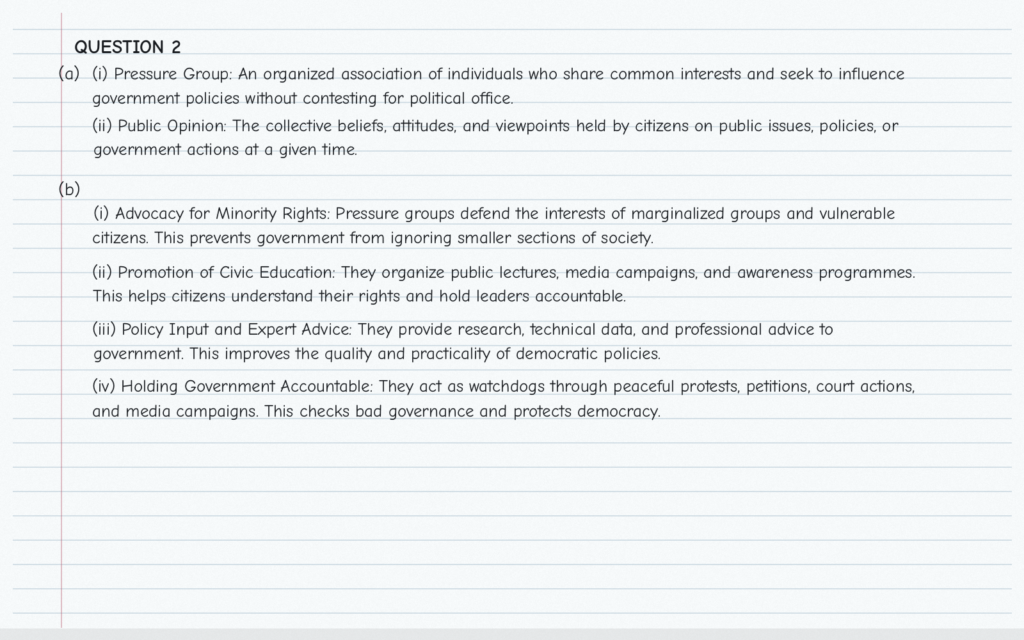
(2a)
Pressure Group: A pressure group is an organised group of people who share common interests and try to influence government policies and decisions without contesting for political power. Examples include trade unions, professional bodies, students’ unions, women groups, and human rights organisations.
Public Opinion: Public opinion refers to the views, beliefs, feelings, or attitudes of the majority of citizens on public issues or government policies at a particular time. It shows what the people think about matters affecting the country.
(2b)
(PICK ANY FOUR)
(i) Protection of the Rights and Interests of Citizens: Pressure groups help to protect the rights and interests of their members and the general public. For example, labour unions can speak against poor salaries, bad working conditions, and unfair treatment of workers. Human rights groups can also speak against unlawful arrest, police brutality, and abuse of power. By doing this, pressure groups help democracy to grow because citizens are not left helpless before the government.
(ii) Influencing Government Policies: Pressure groups influence government policies by making suggestions, sending petitions, organising peaceful protests, and meeting with public officials. They help the government understand the needs and complaints of the people. When government listens to these groups, policies become more people-friendly and democratic.
(iii) Creating Political Awareness: Pressure groups help to educate citizens about their rights, duties, and government activities. They use the media, seminars, rallies, campaigns, and public statements to inform the people about important national issues. This makes citizens more aware and active in political matters, which is very important in a democracy.
(iv) Acting as Watchdogs over Government: Pressure groups monitor the activities of government officials and expose bad governance, corruption, injustice, and abuse of power. When leaders know that pressure groups are watching them, they are more likely to act responsibly. This promotes accountability and reduces misuse of public office.
(v) Promoting Popular Participation in Government: Pressure groups encourage citizens to take part in public affairs, even when they are not members of political parties. Through pressure groups, workers, students, traders, professionals, and ordinary citizens can express their views on national issues. This strengthens democracy because government becomes more responsive to the people.
(vi) Defending Democracy and the Rule of Law: Pressure groups help to defend democratic values such as freedom of speech, peaceful protest, free election, justice, and respect for the constitution. When government tries to act against the law, pressure groups can challenge such actions through court cases, media campaigns, and public pressure. This helps to protect democracy from dictatorship and abuse of power.
ANOTHER TYPE
NUMBER 3
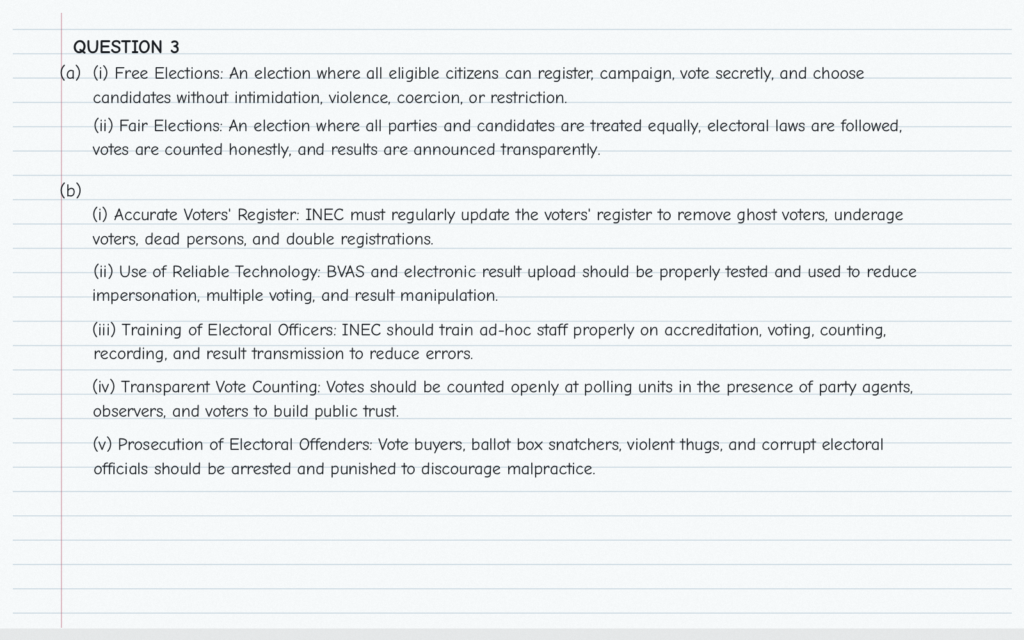
(3a)
(i) Free Election:
A free election is an election in which citizens are allowed to vote for the candidate or political party of their choice without fear, force, intimidation, threat, violence, bribery, or undue influence. In a free election, voters are not stopped from voting, and qualified candidates are allowed to contest without unfair restriction.
(ii) Fair Election:
A fair election is an election conducted according to the electoral laws, where all candidates and political parties are treated equally. In a fair election, votes are properly counted, results are honestly announced, election officials remain neutral, and no candidate is given an illegal advantage over others.
(3b)
(PICK ANY FOUR)
(i) Compilation of an Accurate Voters’ Register
INEC can promote the integrity of elections by preparing a clean and correct voters’ register. The names of dead people, underage voters, foreigners, and double registrations should be removed. When the voters’ register is accurate, it reduces impersonation, multiple voting, and other forms of electoral fraud.
(ii) Proper Training of Election Officials
INEC should train presiding officers, returning officers, and other election workers properly before election day. They should understand how to use election materials, handle voters, count votes, record results, and report problems. Well-trained officials will make fewer mistakes and will be less likely to be manipulated by politicians.
(iii) Use of Reliable Election Technology
INEC should make proper use of technology such as BVAS and electronic transmission of results where applicable. These tools can help to reduce multiple voting, fake accreditation, and manipulation of results. However, INEC must test the machines before election day and provide backup plans in case of technical failure.
(iv) Prompt Distribution of Election Materials
Election materials should arrive at polling units early. Ballot papers, result sheets, BVAS machines, ink, voting cubicles, and other materials should be properly distributed before voting starts. Late arrival of materials can discourage voters, create confusion, and give room for rigging.
(v) Neutrality and Independence of INEC Officials
INEC officials must not support any political party or candidate. They should act as neutral officers and follow the electoral law strictly. When INEC officials are honest and independent, voters will have more confidence in the election process.
(vi) Effective Security During Elections
INEC should work with security agencies to provide adequate security at polling units, collation centres, and result announcement centres. Security officers should protect voters, election officials, and election materials. They should also prevent ballot box snatching, violence, intimidation, and disruption of voting.
(vii) Transparent Counting and Announcement of Results
Votes should be counted openly at the polling units in the presence of party agents, observers, and voters. The results should be recorded correctly and announced clearly. This helps to reduce suspicion and makes it difficult for results to be changed secretly.
(viii) Punishment of Electoral Offenders
INEC should work with the police and courts to ensure that people who commit electoral offences are punished. Those involved in vote buying, ballot snatching, result manipulation, violence, and impersonation should face the law. When offenders are punished, others will be discouraged from committing electoral crimes.
ANOTHER TYPE
NUMBER 4
(4a)
(PICK ANY THREE)
(i) Implementation of government policies and programmes.
(ii) Advising government on policy matters.
(iii) Keeping official government records and documents.
(iv) Collection of government revenue and management of public funds.
(v) Preparation of annual budget and financial reports.
(vi) Provision of social services to the public.
(4b)
(PICK ANY FOUR)
(i) Proper Record Keeping
The Civil Service promotes accountability by keeping proper records of government activities, decisions, income, expenditure, contracts, and official correspondence. When records are well kept, it becomes easier to know how public funds are used and who is responsible for each action taken in government offices.
(ii) Budget Preparation and Control
Civil servants help in preparing the annual budget and making sure that government ministries and departments spend money according to approved plans. This prevents reckless spending and ensures that public money is used for the purposes for which it was approved.
(iii) Financial Auditing
The Civil Service promotes accountability through regular auditing of public accounts. Auditors examine government income and expenditure to confirm whether public funds have been properly used. If fraud, waste, or misuse of funds is discovered, the officers involved can be investigated and punished.
(iv) Observance of Rules and Regulations
Civil servants are expected to follow civil service rules, financial regulations, and due process in carrying out their duties. These rules guide how public officers should behave, how contracts should be awarded, and how government resources should be managed. This helps to reduce corruption and abuse of office.
(v) Supervision and Reporting
Senior officers supervise the work of junior officers and demand regular reports from them. Through supervision, mistakes, negligence, and dishonest practices can be discovered early. Regular reporting also makes public officers answerable for the duties assigned to them.
(vi) Disciplinary Measures Against Erring Officers
The Civil Service has procedures for disciplining officers who engage in misconduct, corruption, lateness, absenteeism, or misuse of government property. Punishment may include warning, suspension, demotion, dismissal, or prosecution. This helps to make public officers responsible and careful in the performance of their duties.
(vii) Due Process in Contract Awards
The Civil Service promotes accountability by ensuring that government contracts follow due process. Contracts should be advertised, properly examined, and awarded to qualified contractors. This reduces favoritism, inflated contracts, and diversion of public funds.
Number 5
(5a)
(PICK ANY THREE)
(i) To provide essential services to the public at affordable rates.
(ii) To prevent private monopoly in important sectors of the economy.
(iii) To promote economic development and national growth.
(iv) To create employment opportunities for citizens.
(v) To manage strategic industries on behalf of the government.
(vi) To provide services that private investors may not be willing to provide.
(5b)
(i)Removal of Government Subsidies: Forcing corporations to generate their own operational revenue eliminates financial dependency on the state budget. This instills strict financial discipline and cost-cutting measures.
(ii)Introduction of Market-Driven Pricing: Allowing firms to charge cost-reflective tariffs enables them to recover operational expenses. This provides the necessary cash flow to properly maintain equipment and infrastructure.
(iii)Autonomy from Political Interference: Commercialization gives boards the freedom to make quick managerial and operational decisions without ministerial approval. This accelerates corporate productivity and response times.
(iv)Merit-Based Employment Practices: Transitioning to profit-driven operations forces corporations to hire skilled professionals based on merit rather than political nepotism. This optimizes overall staff productivity and service delivery
Number 6
(6)
(i)The Oba (Monarchy): Acted as the executive head of the kingdom. This structure mirrors the modern-day executive branch, providing centralized leadership and a symbolic figurehead of unity.
(ii)The Oyomesi (Council of Chiefs): Served as a council of kingmakers and advisors, checking the powers of the Oba. This functions similarly to modern parliaments or senates by balancing executive authority.
(iii)The Ogboni Society (Judiciary/Mediators): Played a major role in settling disputes and checking the Oyomesi and Oba. This represents an independent judicial and regulatory body safeguarding constitutional balance.
(iv)The Esare/Balogun (Military/Defense): Organized the defense and security of the state. This is highly relevant to modern-day state security architectures, territorial defense, and law enforcement.
(v)Town and Village Assemblies (De-centralization): Local administration handled community affairs autonomously. This mirrors modern local government councils and grassroots governance, which bring administration closer to citizens.
Number 7
(7)
(i)Introduction of Federalism: Power was formally divided between a central government and three distinct regional governments (North, West, and East), creating a true federal system.
(ii)Autonomy of Regions: Regional governments became residual power centers. They were granted autonomous legislative and executive powers over local matters, reducing central control.
(iii)The Governor-General: The Governor of Nigeria was redesignated as Governor-General at the federal center. This post held vital executive authority and veto power over central legislation.
(iv)Regional Governors: Regional Lieutenant-Governors were elevated to the rank of Governors. They headed the regional executive councils and exercised executive powers within their territories.
(v)Exclusive and Concurrent Lists: Power was categorized into an Exclusive List (federal jurisdiction only, like defense) and a Concurrent List (shared by federal and regional, though federal law prevailed in conflicts).
Number 8
(8)
(i)Suspension of the Constitution: Military regimes consistently suspended or modified democratic constitutions. This action destroyed the legal framework establishing civil rights and institutional checks.
(ii)Destruction of Democratic Structures: Democratic bodies like parliaments, political parties, and elected local councils were abolished. This stifled political participation and civilian leadership training.
(iii)Weakening of civil liberties: Military decrees led to arbitrary detentions, suppression of free speech, and media censorship. This systematically eroded the culture of human rights.
(iv)Centralization of Power: The military ran a unified command structure. This undermined Nigeria’s federal arrangement by concentrating wealth and authority at the center, leaving states dependent.
(v)Erosion of Judicial Independence: Military regimes ruled through decrees containing “ouster clauses.” These clauses blocked courts from reviewing government actions, subverting the rule of law.
Number 9
(9)
(i)Recognition of Traditional Rulers: The policy allowed African chiefs and traditional authorities to take part in local administration. This made governance closer to the people and gave indigenous leaders a role in decision-making.
(ii)Use of Native Institutions: Existing African political institutions were preserved and used in governing the colonies. This encouraged local participation because people could relate better with their familiar traditional systems.
(iii)Creation of Local Councils: The French created advisory and local councils where selected Africans could express the needs and opinions of their communities. This gave the people a limited voice in administration.
(iv)Involvement of Educated Africans: Educated Africans were allowed to work in the colonial civil service and participate in administrative duties. This helped Africans gain political experience and influence government policies.
(v)Representation in French Political Bodies: Some Africans, especially from the communes of Senegal, were allowed to elect representatives to French political institutions. This gave them a channel to present African interests before the French government.
Number 10
(10)
(i)Promotion of Nigerian Nationalism: The NYM helped to awaken political consciousness among Nigerians. It encouraged Nigerians to see themselves as one people capable of demanding self-government from British colonial rule.
(ii)Demand for Constitutional Reforms: The movement strongly criticized colonial policies and demanded greater African participation in government. This pressure contributed to later constitutional changes that moved Nigeria closer to independence.
(iii)Unity Across Ethnic Lines: The NYM attracted members from different ethnic groups, including Yoruba, Igbo, and others. This showed that Nigerians could unite politically despite tribal differences.
(iv)Political Education of Nigerians: Through speeches, newspapers, meetings, and campaigns, the NYM educated Nigerians about their rights and the need for political freedom. This helped prepare the people for nationalist struggle.
(v)Training of Future Nationalist Leaders: The movement produced and influenced important nationalist figures such as Nnamdi Azikiwe, H.O. Davies, Ernest Ikoli, and others. These leaders later played major roles in Nigeria’s journey to independence.
(vi)Opposition to Colonial Domination: The NYM openly challenged British control and demanded more respect for Nigerians in administration, education, and public service. This weakened colonial authority and strengthened the call for independence.
(vii)Foundation for Later Political Parties: The activities of the NYM helped lay the groundwork for later nationalist parties like the NCNC and Action Group. These parties continued the struggle until Nigeria gained independence in 1960.
COMPLETED!!!
Government is the study of the institutions, processes, principles, and activities involved in the administration and management of a state. It examines how political power is acquired, exercised, and controlled within a society. Government also studies the relationship between the state and its citizens, the rights and duties of individuals, political systems, constitutions, political parties, elections, and international relations. The subject helps students understand how societies are organized and governed and how citizens participate in the political process.
Every organized society requires a system through which laws are made, enforced, and interpreted. Without government, there would be disorder, insecurity, and confusion. Government exists to maintain law and order, protect lives and property, provide essential services, promote justice, and ensure the welfare of citizens. It serves as the machinery through which the affairs of a state are managed.
The state is a politically organized group of people occupying a defined territory under a sovereign government. Four important elements are necessary for the existence of a state. These are population, territory, government, and sovereignty. Population refers to the people living within a state. Territory refers to the geographical area occupied by the state. Government is the institution responsible for managing the affairs of the state, while sovereignty refers to the supreme authority of a state to govern itself without external interference.
Government can be defined as the institution through which the will of the state is expressed and implemented. It is the machinery established to make laws, enforce laws, and administer justice. Government provides leadership, formulates policies, maintains peace and security, and promotes national development. Through government, public resources are managed, and the needs of citizens are addressed.
The functions of government are numerous and important. One of its primary responsibilities is the maintenance of law and order. Government establishes laws and ensures that citizens obey them. It provides security through institutions such as the police, armed forces, and other security agencies. Government also protects the country from external aggression and internal disturbances.
Another important function of government is the provision of social services. Governments establish schools, hospitals, roads, water supply systems, and other public facilities. These services improve the standard of living of citizens and contribute to national development. Government also regulates economic activities, promotes employment opportunities, and creates an environment that encourages investment and growth.
A constitution is one of the most important concepts in government. A constitution is the body of fundamental laws and principles that guide the operation of a state. It defines the powers of government institutions, outlines the rights of citizens, and establishes the framework for governance. The constitution is regarded as the supreme law of the land because all other laws derive their authority from it.
The constitution serves several important purposes. It limits the powers of government officials, protects the rights of citizens, and provides procedures for resolving disputes. It also promotes political stability by clearly defining the roles and responsibilities of various institutions. A country without a constitution would find it difficult to maintain an orderly system of governance.
Political power is exercised through different systems of government. One of the most common systems is democracy. Democracy is a system of government in which political power resides with the people. In a democratic state, leaders are chosen through regular, free, and fair elections. Citizens have the right to participate in government either directly or through elected representatives. Democracy promotes political participation, accountability, freedom of expression, and respect for human rights.
Another form of government is monarchy. In a monarchy, political authority is vested in a king, queen, emperor, or other hereditary ruler. Monarchy may be absolute or constitutional. In an absolute monarchy, the ruler possesses extensive powers and authority. In a constitutional monarchy, the powers of the monarch are limited by a constitution, and elected officials perform most governmental functions.
Military government is another system in which political power is controlled by members of the armed forces. Military governments usually emerge through coups d’état and often suspend constitutional rule. Although military governments may promise stability and reform, they are generally characterized by limited political participation and restrictions on civil liberties.
Government is commonly divided into three main organs: the legislature, the executive, and the judiciary. These organs perform different functions but work together to ensure effective governance.
The legislature is the law-making body of government. Its primary responsibility is to make, amend, and repeal laws. The legislature also approves government expenditures, represents the interests of citizens, and monitors the activities of the executive. In many democratic countries, the legislature is composed of elected representatives who act on behalf of the people.
The executive is responsible for implementing and enforcing laws. It includes the president, governors, ministers, commissioners, and civil servants who manage government affairs. The executive formulates policies, administers public services, and ensures that laws passed by the legislature are effectively implemented. The success of government policies often depends on the efficiency of the executive arm.
The judiciary is the organ responsible for interpreting laws and administering justice. Courts ensure that laws are applied fairly and that disputes are resolved according to legal principles. The judiciary protects citizens’ rights, settles conflicts, and ensures that government actions conform to the constitution. Judicial independence is important because it allows judges to perform their duties without political interference.
The principle of separation of powers is an important feature of modern democratic systems. It involves dividing governmental powers among the legislature, executive, and judiciary to prevent the concentration of authority in one institution. Separation of powers promotes accountability, prevents abuse of power, and protects democratic governance. Closely related to this principle is the system of checks and balances, which allows each organ of government to monitor and limit the powers of the others.
Political parties play a significant role in government and politics. A political party is an organized group of people with similar political ideas and objectives who seek to gain political power through elections. Political parties educate citizens, recruit leaders, formulate policies, and provide alternatives in governance. They serve as a link between the government and the people and help strengthen democratic institutions.
Elections are essential components of democratic government. An election is the process through which citizens choose their leaders by voting. Elections provide opportunities for citizens to express their preferences and participate in decision-making. Free and fair elections enhance political legitimacy and promote accountability. They ensure that leaders remain responsive to the needs and aspirations of the people.
Citizenship is another important topic in Government. A citizen is a legally recognized member of a state who enjoys certain rights and privileges while also performing specific duties and obligations. Citizens are entitled to rights such as freedom of expression, freedom of association, and protection under the law. At the same time, they are expected to obey laws, pay taxes, vote in elections, and contribute to national development.
Human rights are fundamental freedoms and privileges guaranteed to individuals by law. These rights include the right to life, personal liberty, fair hearing, freedom of movement, freedom of religion, and freedom of expression. Governments have a responsibility to protect these rights and ensure that citizens enjoy them without discrimination or oppression.
Local government is the level of government closest to the people. It is established to administer local affairs and promote grassroots development. Local governments provide services such as sanitation, primary education, local roads, markets, and community development projects. They also encourage citizen participation in governance and help bring government closer to the people.
Public administration is the process through which government policies and programs are implemented. It involves the activities of civil servants and public officials responsible for managing government institutions. Effective public administration promotes efficiency, accountability, and the successful delivery of public services.
International relations is another important aspect of Government. It deals with the interactions between sovereign states and international organizations. Countries cooperate through diplomacy, trade, treaties, and membership in international organizations. International relations promote peace, economic cooperation, and the resolution of global challenges.
Some important international organizations include the United Nations, the African Union, and the Economic Community of West African States. These organizations promote cooperation, security, development, and peaceful relations among member states.
One of the major challenges facing governments today is corruption. Corruption involves the misuse of public office or authority for personal gain. It weakens institutions, reduces public trust, wastes resources, and hinders development. Governments combat corruption through transparency, accountability, anti-corruption agencies, and strong legal frameworks.
Good governance is characterized by accountability, transparency, responsiveness, participation, and adherence to the rule of law. A government that practices good governance uses public resources responsibly, respects citizens’ rights, and promotes sustainable development. Good governance strengthens democratic institutions and improves the quality of life of citizens.
In conclusion, Government is the study of the institutions, principles, and processes involved in the management of the state. It examines how power is acquired, exercised, and controlled within society. The subject provides knowledge about constitutions, political systems, elections, political parties, citizenship, human rights, and international relations. Through the study of Government, students gain a better understanding of political processes, democratic values, leadership, and responsible citizenship. This knowledge enables them to participate actively in public affairs and contribute meaningfully to national development and good governance.


Leave a comment