
Yoruba WAEC Answers 2026
YORUBA OBJ
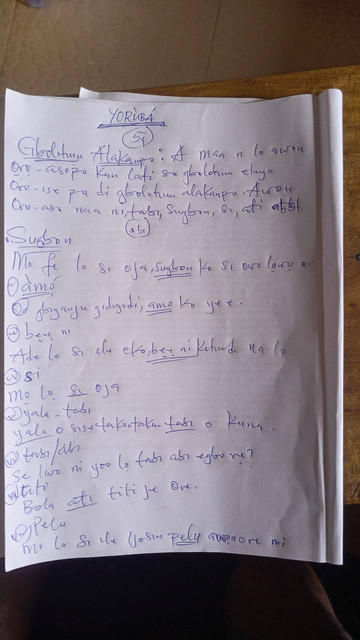
01-10: ACBCBABDCA
11-20: CBABBABDBA
21-30: DCCABBBDBC
31-40: DCABCADDDD
41-50: BACBADDDAC
COMPLETED!!!
Number 2
(2)
(a) Àwọn àpẹẹrẹ ọrọ pẹlú kọnṣónántì Yorùbá (márùn-ún):
bàtà, ilẹ, ọkọ, ọjọ, kẹkẹ
(b) Àwọn míì márùn-ún:
dídùn, gángan, ṣọọṣì, àjà, fọtò
————————————————————————————————-
(3)
Àpẹẹrẹ ìlànà sílèbù
(a) KF-KF: bàtà, kẹkẹ
(b) KF-N-KF-KF: bà-ná-nà (banana), tàbí kò-kò-rò
(d) F-KF: à-gbo, ẹ-ja
(e) KF-N-KF: bà-nú, kò-nà
(f) F-KF-KF: à-bà-dá, ẹ-lé-gbè
Number 5
Answers Loading……
Students are encouraged to refresh this page often because updates can come at any time. Once the Yoruba answers are available, they will be posted here immediately with full details. We wish all Yoruba students success in their WAEC exams.
Yoruba is one of the three major indigenous languages spoken in Nigeria. It is widely spoken in the South-Western part of the country, especially in states such as Lagos State, Oyo State, Ogun State, Osun State, Ondo State, and Ekiti State. It is also spoken in parts of Benin and Togo, as well as by Yoruba communities around the world. In the West African Examinations Council (WAEC), Yoruba is offered as a subject to help students develop their ability to read, write, speak, and understand the language. It also teaches students about Yoruba literature, history, and cultural traditions.
Yoruba belongs to the Niger-Congo language family. It is a tonal language, which means that the meaning of a word can change depending on how it is pronounced. Standard Yoruba is the form taught in schools and used in WAEC examinations. The language is written with the Roman alphabet and includes tone marks and special symbols that guide pronunciation and meaning.
The WAEC Yoruba syllabus is designed to test students in grammar, comprehension, composition, oral traditions, and literature. The examination usually includes reading passages, essay questions, grammar exercises, and questions based on prescribed literary texts. Students are expected to demonstrate a good understanding of vocabulary, sentence structure, and cultural expressions.
In the comprehension section, students read passages written in Yoruba and answer questions based on the content. They may be asked to explain difficult words, identify main ideas, and summarize important details. This section tests students’ reading ability and understanding of written Yoruba.
The composition section requires students to write essays in Yoruba on different topics such as education, family life, agriculture, health, and cultural events. To perform well, students must organize their ideas clearly and use correct grammar, spelling, and punctuation. Good composition writing reflects creativity and proper use of vocabulary.
Grammar is a major part of the WAEC Yoruba examination. Students are tested on nouns, verbs, pronouns, adjectives, adverbs, and sentence patterns. They may also be asked to transform sentences, fill in blanks, and explain idiomatic expressions and proverbs. A strong knowledge of grammar enables students to communicate accurately and effectively.
Yoruba literature consists of both oral and written works. Oral literature includes folktales, proverbs, praise poetry (oríkì), riddles, and songs. These forms of literature preserve history and teach moral lessons about honesty, respect, courage, and hard work. Written literature includes poems, plays, and novels by Yoruba authors. Through literature, students gain a deeper appreciation of the richness of the language.
Yoruba culture places great value on respect for elders, communal living, and strong family ties. Traditional ceremonies such as naming ceremonies, weddings, and festivals are important aspects of Yoruba life. Festivals like the Osun-Osogbo Festival celebrate spirituality, heritage, and community unity. During such events, people wear colorful traditional attire, perform dances, and offer prayers and thanksgiving.
Leave a comment