
WAEC Chemistry Practical (Alternate A)
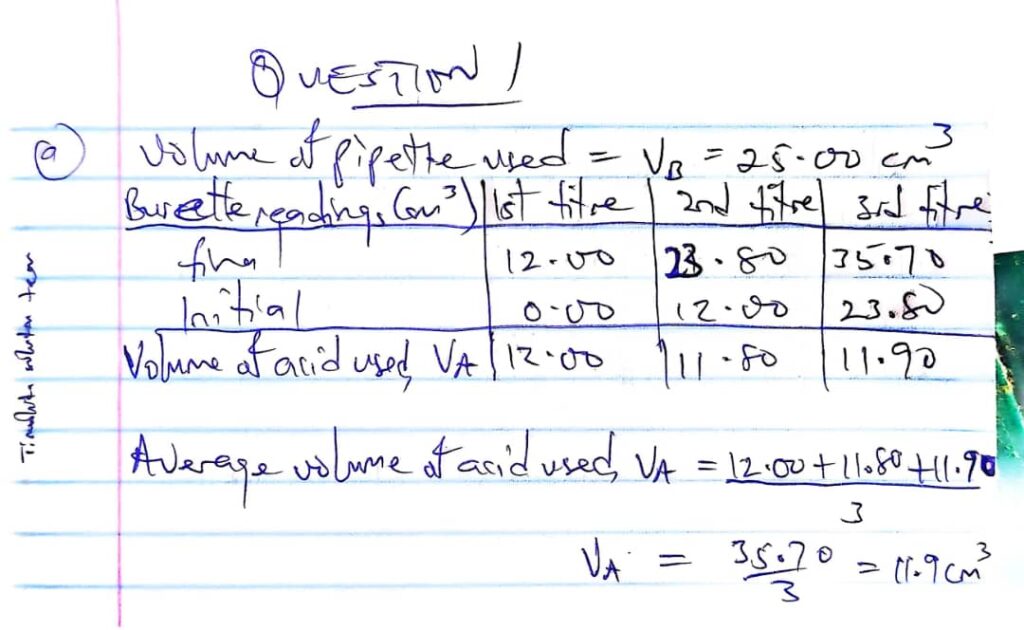
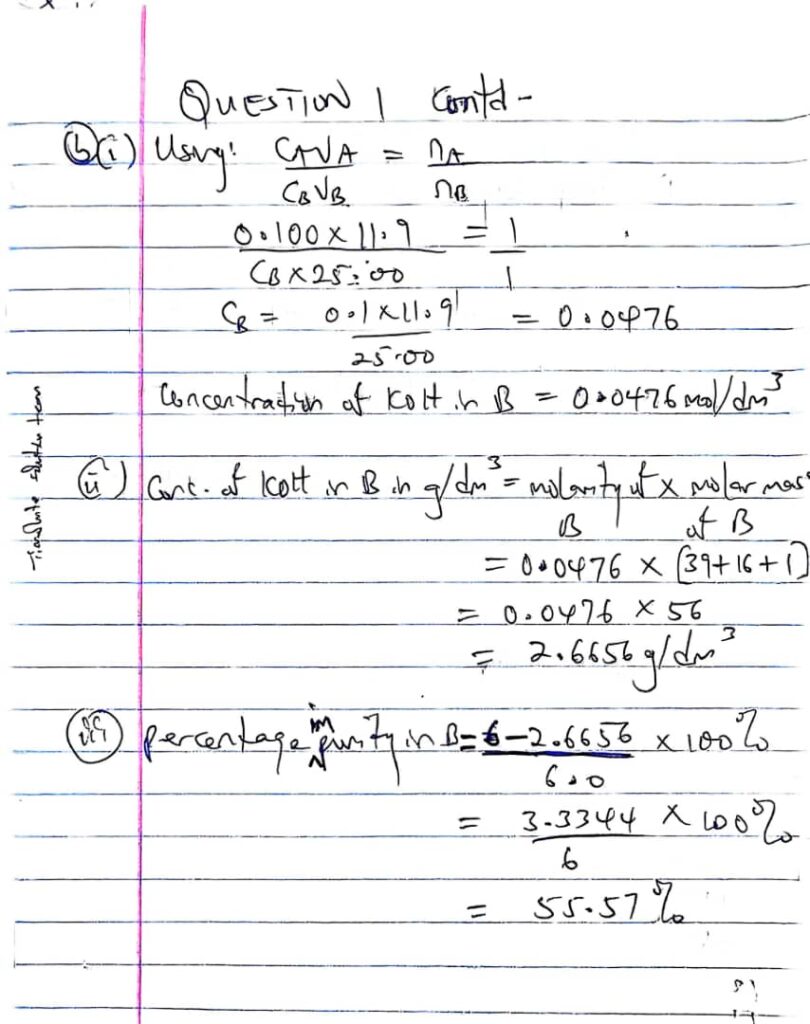
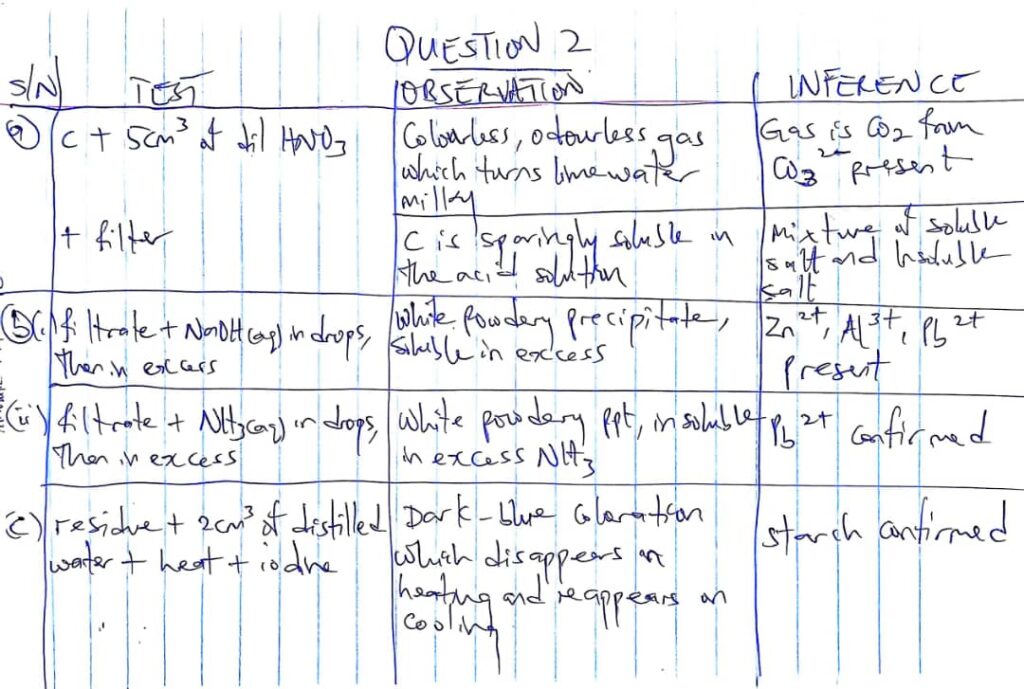
Number 3
(3a)
Complete the table
Under; Apparatus
(i) Measuring cylinder (or Pipette / Burette)
(ii) Clay triangle
(iii) Crucible
(iv) Bomb calorimeter
Under; Use
(i)For measuring specific volume of a liquid
(ii)To support a crucible being heated by a Bunsen burner
(iii)As container for melting and heating to a very high temperature
(iv)To measure the heat of combustion of a particular reaction
(3b)
(i)PbSO⁴ (Insoluble)
(ii)PbCl² (slightly soluble in cold water, soluble in hot water
(iii)Pb(NO³)² (soluble)
Order; PbSO⁴ <PbCl² <Pb (NO³)²
(3c)
(i)KNO³(aq); No effect. It is a neutral salt formed from strong acid (HNO³) and a strong base (KOH)
(ii)K²CO³; turns red litmus blue. It is a basic salt formed from a weak acid (H²CO³) and strong base (KOH)
(iii)Al²(SO⁴)³(aq); turns blue litmus red. It is an acidic salt; aluminium ions undergo hydrolysis in water to produce H+ ions
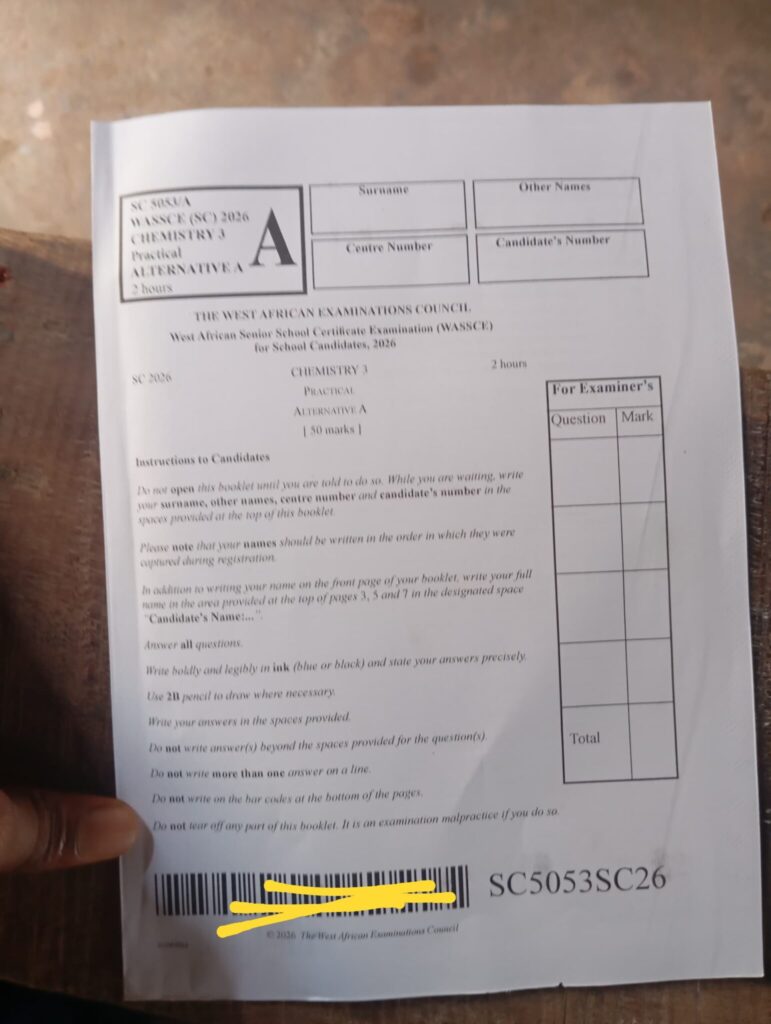
WAEC Chemistry Practical is one of the most important parts of the West African Senior School Certificate Examination (WASSCE). It tests students’ ability to carry out experiments, make observations, record results, and draw correct conclusions. Unlike the theory paper, the practical paper requires students to work with real chemicals and laboratory equipment.
Many students are afraid of Chemistry Practical because they think it is difficult. However, with proper understanding and regular practice, it becomes one of the easiest papers to pass. The practical examination follows a regular pattern every year. Students are usually tested on qualitative analysis, titration, and simple experiments involving gases, salts, acids, and bases.
The purpose of this expository note is to explain WAEC Chemistry Practical in simple English. It covers laboratory apparatus, safety rules, titration, qualitative analysis, calculations, and examination tips.
Meaning of Chemistry Practical
Chemistry Practical is the aspect of chemistry that involves performing experiments in the laboratory. It allows students to confirm chemical theories through direct observation and measurement.
In WAEC, Chemistry Practical tests the following skills:
- Ability to identify laboratory apparatus.
- Ability to carry out experiments correctly.
- Ability to observe and record changes.
- Ability to write balanced equations.
- Ability to calculate results accurately.
- Ability to draw valid conclusions.
Chemistry Practical is not based on guesswork. It requires careful observation and attention to detail.
Objectives of WAEC Chemistry Practical
The practical examination is designed to help students:
- Develop laboratory skills.
- Understand chemical reactions.
- Learn how to handle chemicals safely.
- Interpret experimental data.
- Improve accuracy and precision.
- Apply theoretical knowledge to real situations.
Laboratory Safety Rules
Safety is very important in the chemistry laboratory. Students must follow all safety rules to avoid accidents.
General Safety Rules
- Wear a laboratory coat.
- Read instructions carefully.
- Do not taste chemicals.
- Avoid smelling chemicals directly.
- Handle acids with care.
- Keep the working area clean.
- Wash hands after experiments.
- Report any spill immediately.
- Do not run in the laboratory.
- Use apparatus properly.
Why Safety is Important
Chemicals can burn the skin, damage the eyes, or release harmful gases. Proper safety measures protect students and ensure successful experiments.
Common Laboratory Apparatus and Their Uses
Test Tube
Used for heating and mixing small quantities of substances.
Beaker
Used for holding and mixing liquids.
Conical Flask
Used during titration because it allows easy swirling.
Burette
Used to deliver measured volumes of solution accurately.
Pipette
Used to transfer a fixed volume of liquid, usually 25 cm³.
Measuring Cylinder
Used to measure liquids.
Funnel
Used for pouring liquids and filtration.
Filter Paper
Used to separate insoluble solids from liquids.
Retort Stand
Used to hold burettes and other apparatus.
Wash Bottle
Used to rinse apparatus with distilled water.
Spatula
Used to transfer solid chemicals.
Evaporating Dish
Used to evaporate liquids.
Crucible
Used for strong heating.
Bunsen Burner
Provides heat.
Thermometer
Measures temperature.
Balance
Measures mass.
Reagents Commonly Used in WAEC Practical
- Hydrochloric acid (HCl)
- Sulphuric acid (H₂SO₄)
- Nitric acid (HNO₃)
- Sodium hydroxide (NaOH)
- Aqueous ammonia (NH₃)
- Barium chloride (BaCl₂)
- Silver nitrate (AgNO₃)
- Distilled water
These reagents are used to test unknown salts and ions.
Titration
Meaning of Titration
Titration is a method used to determine the concentration of one solution by reacting it with another solution of known concentration.
Apparatus Used in Titration
- Burette
- Pipette
- Conical flask
- Funnel
- White tile
- Indicator
Indicators
Indicators change color at the end point.
| Indicator | Acid Color | Alkali Color |
|---|---|---|
| Methyl orange | Red | Yellow |
| Phenolphthalein | Colorless | Pink |
Titration Procedure
- Rinse the burette with the acid.
- Fill the burette and record the initial reading.
- Rinse the pipette with the base.
- Transfer 25.0 cm³ of the base into the flask.
- Add 2–3 drops of indicator.
- Run acid into the flask while swirling.
- Stop when color changes permanently.
- Record the final reading.
- Calculate titre.
- Repeat until concordant results are obtained.
Titre
Titre = Final burette reading − Initial burette reading
Concordant Results
Concordant titres are two or more readings that differ by not more than 0.10 cm³.
Example:
- 24.50 cm³
- 24.55 cm³
These are concordant.
Titration Calculations
Use:
Moles = Concentration × Volume (in dm³)
If:
- HCl = 0.1 mol/dm³
- Volume used = 25.0 cm³
Convert volume to dm³:
25.0 cm³ = 0.025 dm³
Moles = 0.1 × 0.025 = 0.0025 mol
Qualitative Analysis
Qualitative analysis involves identifying ions present in a substance.
Tests for Cations
Copper(II) Ion (Cu²⁺)
- NaOH: Light blue precipitate.
- Excess NaOH: Insoluble.
- NH₃: Light blue precipitate.
- Excess NH₃: Deep blue solution.
Iron(II) Ion (Fe²⁺)
- NaOH: Dirty green precipitate.
- Turns brown on standing.
Iron(III) Ion (Fe³⁺)
- NaOH: Reddish-brown precipitate.
Zinc Ion (Zn²⁺)
- NaOH: White precipitate.
- Excess NaOH: Dissolves.
- Excess NH₃: Dissolves.
Aluminium Ion (Al³⁺)
- NaOH: White precipitate.
- Excess NaOH: Dissolves.
- Excess NH₃: Insoluble.
Calcium Ion (Ca²⁺)
- NaOH: White precipitate, insoluble in excess.
Ammonium Ion (NH₄⁺)
- Warm with NaOH.
- Ammonia gas evolved.
- Turns red litmus blue.
Tests for Anions
Carbonate (CO₃²⁻)
- Add dilute acid.
- Effervescence occurs.
- Gas turns limewater milky.
Sulphate (SO₄²⁻)
- Acidify and add BaCl₂.
- White precipitate forms.
Chloride (Cl⁻)
- Acidify and add AgNO₃.
- White precipitate forms.
Bromide (Br⁻)
- Cream precipitate.
Iodide (I⁻)
- Yellow precipitate.
Nitrate (NO₃⁻)
- Warm with NaOH and aluminum foil.
- Ammonia gas produced.
Gas Tests
Hydrogen
Burns with a pop sound.
Oxygen
Relights a glowing splint.
Carbon Dioxide
Turns limewater milky.
Ammonia
Turns damp red litmus paper blue.
Chlorine
Bleaches damp litmus paper.
Sulphur Dioxide
Turns acidified potassium dichromate from orange to green.
Flame Tests
| Metal Ion | Flame Color |
|---|---|
| Sodium | Yellow |
| Potassium | Lilac |
| Calcium | Brick red |
| Copper | Blue-green |
Solubility Rules
Soluble Salts
- All nitrates.
- All sodium, potassium, and ammonium salts.
- Most chlorides.
- Most sulphates.
Insoluble Salts
- Most carbonates.
- Most hydroxides.
Heating Tests
When salts are heated:
- Hydrated salts lose water.
- Carbonates release CO₂.
- Ammonium salts release NH₃.
Organic Chemistry Practical Tests
Unsaturation Test
Bromine water changes from orange to colorless.
Ethanol Test
Add acidified potassium dichromate and warm.
Orange changes to green.
Carboxylic Acid Test
Turns blue litmus red.
Electrolysis
Electrolysis is the decomposition of a substance by electric current.
Example: Electrolysis of Water
Products:
- Hydrogen at cathode.
- Oxygen at anode.
Ratio = 2:1
Observation and Inference
In practical exams, students must write observations and inferences.
| Observation | Inference |
|---|---|
| White precipitate | Zn²⁺, Al³⁺, or Ca²⁺ present |
| Effervescence | Carbonate present |
| Deep blue solution | Cu²⁺ present |
| Gas with pop sound | Hydrogen present |
Sources of Errors
- Parallax error.
- Dirty apparatus.
- Air bubbles in burette.
- Overrunning endpoint.
- Wrong reading of meniscus.
Accuracy and Precision
- Accuracy means closeness to the true value.
- Precision means closeness of repeated results.
How WAEC Sets the Practical Paper
The practical paper usually contains:
- Question 1: Titration
- Question 2: Qualitative Analysis
- Question 3: Short Practical Questions
Students are provided with labeled solutions such as:
- A, B, C, D
- Unknown salts
Tips for Answering WAEC Chemistry Practical
- Read instructions carefully.
- Label apparatus properly.
- Record observations immediately.
- Use correct units.
- Repeat titration until concordant results are obtained.
- Memorize all tests for ions and gases.
- Write neat and organized answers.
- Avoid guesswork.
- Practice calculations.
- Manage time wisely.
Common Mistakes to Avoid
- Forgetting units.
- Wrong significant figures.
- Mixing up observations and inferences.
- Not converting cm³ to dm³.
- Using non-concordant titres.
- Spelling chemical names incorrectly.

Leave a comment