
WAEC Physics Answers 2026 (Essay & Obj)
Number 2
(2ai)
Holes
(2aii)
Electrons
(2b)
It requires no heating/filament, so it operates at room temperature and consumes less power.
Number 6
(6a)
A hard magnetic material is a material that is difficult to magnetize but retains its magnetism for a long time after being magnetized.
(6b)
Hausa exam questions
Brownian motion.
Number 6
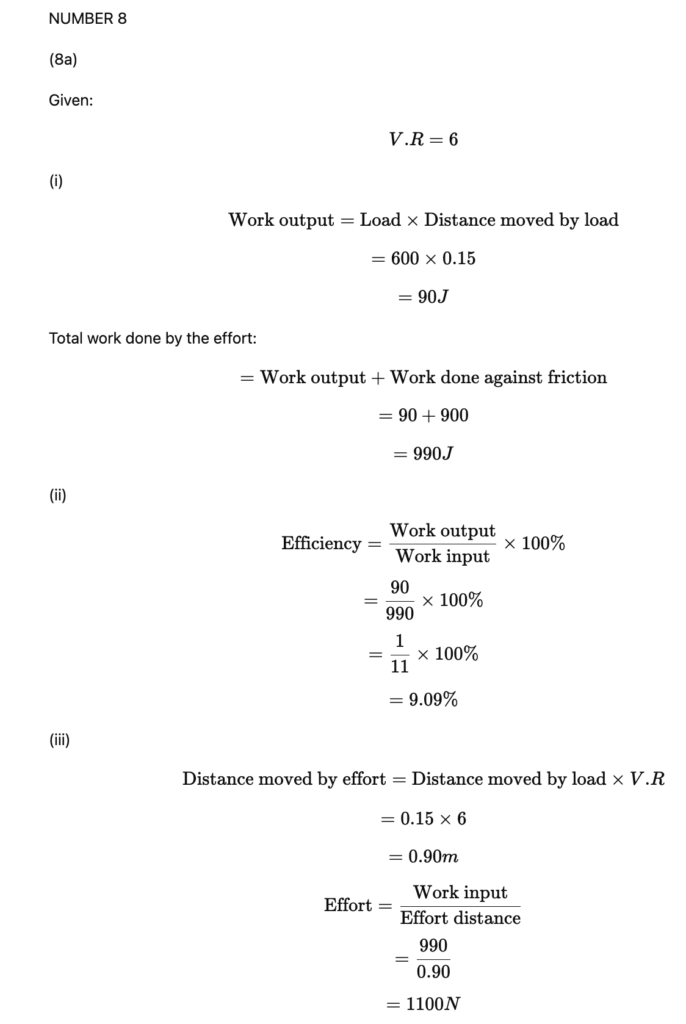
Number 10
(10a)
(i) Persistence of vision is the ability of the human eye to retain an image for a short time after the object has been removed from sight.
(ii) Accommodation is the ability of the eye lens to change its shape or focal length so that clear images of objects at different distances can be formed on the retina.
(10b)
(i) Both the human eye and the camera use a lens to form an image.
(ii) In the human eye, images are formed on the retina, while in a camera, images are formed on a film or light-sensitive sensor.
Physics is one of the major branches of science that deals with the study of matter, energy, and the interactions between them. It seeks to explain the natural phenomena that occur around us and the laws that govern the universe. Everything we see, touch, hear, or experience involves physics in one way or another. The movement of vehicles, the generation of electricity, the transmission of sound through the air, the formation of rainbows, and even the motion of the planets around the Sun are all explained by physics.
The word “physics” comes from a Greek word meaning “nature.” Therefore, physics can be described as the science of nature because it helps us understand how nature operates. It forms the foundation of many scientific and technological fields such as engineering, medicine, telecommunications, aviation, and architecture. Without physics, many modern inventions such as mobile phones, computers, televisions, airplanes, and medical equipment would not exist.
Physics is concerned with quantities that can be measured. Such quantities are called physical quantities. Examples include length, mass, time, temperature, and electric current. To ensure that measurements are accurate and universally accepted, scientists use a standard system of units known as the International System of Units (SI Units). In this system, length is measured in metres (m), mass in kilograms (kg), time in seconds (s), and temperature in kelvin (K). Measurement is a very important aspect of physics because scientific observations and experiments depend on accurate measurements. Instruments such as metre rules, Vernier calipers, micrometer screw gauges, thermometers, and stopwatches are commonly used to measure different physical quantities.
One of the most important concepts in physics is motion. Motion refers to the change in the position of an object with time. An object is said to be in motion when it changes its position relative to another object or point. For example, a moving car, a flying bird, and a running athlete are all in motion. The study of motion helps scientists understand how objects move and the factors affecting their movement.
The speed of an object is defined as the distance travelled per unit time.
Speed=TimeDistance
For example, if a car travels 100 metres in 10 seconds, its speed is 10 metres per second. While speed tells us how fast an object moves, velocity gives both the speed and direction of motion. Acceleration is another important quantity related to motion. It refers to the rate at which velocity changes with time. A car that increases its speed from 20 m/s to 40 m/s is accelerating. Acceleration may be positive when speed increases or negative when speed decreases.
Force is another fundamental concept in physics. A force is simply a push or pull acting on an object. Forces can cause an object to start moving, stop moving, change direction, or change shape. When a footballer kicks a ball, a force is applied to the ball. When a person pushes a door open, force is also applied. Sir Isaac Newton developed three laws of motion that explain how forces affect moving objects. Newton’s First Law states that a body will remain at rest or continue moving with uniform velocity in a straight line unless acted upon by an external force. This law introduces the concept of inertia, which is the tendency of a body to resist changes in its state of motion.
Newton’s Second Law explains the relationship between force, mass, and acceleration.
F=ma
This means that the force acting on an object is equal to the product of its mass and acceleration. The greater the force applied, the greater the acceleration produced. Newton’s Third Law states that for every action, there is an equal and opposite reaction. This law explains why a gun recoils when fired and why rockets can move through space.
The concepts of work, energy, and power are also central to physics. Work is said to be done whenever a force causes an object to move through a distance in the direction of the force. For example, lifting a bucket of water from the ground to a table involves doing work.
W=Fd
The unit of work is the joule (J). Energy is defined as the capacity or ability to do work. Every activity performed by humans, animals, or machines requires energy. Energy exists in various forms, including mechanical energy, heat energy, chemical energy, electrical energy, sound energy, and light energy. One important law in physics is the law of conservation of energy, which states that energy can neither be created nor destroyed but can only be transformed from one form to another.
A moving object possesses kinetic energy.
KE=21mv2
m
kg
v
m/s
m is mass; v is velocity.
KE=21mv2=21(4)(6)2=72JKE = 72 J
On the other hand, an object may possess potential energy due to its position above the ground.
PE=mgh
m
kg
h
m
m is mass; h is height.
PE=mgh=3.4×9.8×9=299.88J
Gravity is fixed at g = 9.8 in this visualization.h
Power is the rate at which work is done or energy is transferred.
P=tW
The SI unit of power is the watt (W).
Heat is another important area of physics. Heat is a form of energy that flows from a hotter body to a colder body because of a difference in temperature. Temperature is a measure of the degree of hotness or coldness of a body. Heat can be transferred in three main ways: conduction, convection, and radiation. Conduction occurs mainly in solids and involves the transfer of heat through direct contact between particles. Convection occurs in liquids and gases through the movement of heated particles. Radiation involves the transfer of heat through electromagnetic waves and does not require a material medium. The Sun transfers heat to the Earth through radiation.
The study of waves is also an important part of physics. A wave is a disturbance that transfers energy from one point to another without the actual movement of matter. Waves can be mechanical or electromagnetic. Mechanical waves require a material medium for transmission. Examples include sound waves and water waves. Electromagnetic waves do not require a medium and can travel through a vacuum. Examples include light waves, radio waves, X-rays, and microwaves.
The relationship between wave speed, frequency, and wavelength is expressed as:
v=fλ
f
Hz
λ
m
f is frequency; λ is wavelength; v is wave speed.
v=fλ=2×3=6m/sλ
Sound is a form of energy produced by vibrating bodies. When an object vibrates, it causes nearby particles of air to vibrate, thereby producing sound waves. Sound cannot travel through a vacuum because it requires a medium. The pitch of a sound depends on its frequency, while its loudness depends on its amplitude. Sound is used for communication, entertainment, navigation, and medical diagnosis.
Light is a form of electromagnetic energy that enables us to see objects. It travels in straight lines and has a very high speed in a vacuum. Light can be reflected, refracted, dispersed, and diffracted. Reflection occurs when light bounces back from a surface. This principle is used in mirrors. Refraction occurs when light changes direction as it passes from one medium to another, such as from air into water. Refraction explains why a stick partially immersed in water appears bent.
Electricity is one of the most useful applications of physics in everyday life. Electricity involves the movement of electric charges through conductors. Electric current is the rate at which electric charge flows through a conductor.
I=tQ
Electric current is measured in amperes. Voltage is the force that drives electric charges through a conductor, while resistance is the opposition to the flow of electric current. The relationship among voltage, current, and resistance is explained by Ohm’s Law.
V=IR
Vs
V
R
Ω
I=RVs=6.0Ω12.0V=2.00AVs = 12.0 V+-R = 6.0 ΩI = 2.00 A
Electricity powers homes, industries, schools, hospitals, and communication systems.
Magnetism is the branch of physics that studies magnets and magnetic fields. A magnet is an object capable of attracting magnetic materials such as iron, cobalt, and nickel. Magnets have two poles known as the north pole and south pole. Like poles repel each other, while unlike poles attract. Magnetism is applied in electric motors, generators, loudspeakers, transformers, and compasses used for navigation.
Another important concept in physics is gravity. Gravity is the force of attraction between masses. The Earth’s gravitational force pulls objects toward its centre and is responsible for giving objects weight. When an object is released from a height, gravity causes it to fall towards the Earth. The weight of a body depends on its mass and the acceleration due to gravity.
W=mg
m
kg
g
m/s^2
Fg=mg≈78.4Nm=8kgF_g=78.4Ng=9.8 m/s^2
Physics has contributed greatly to human development and technological advancement. It has led to the invention of machines, transportation systems, communication devices, medical equipment, and industrial tools that improve the quality of life. Through physics, scientists continue to explore the mysteries of the universe and develop solutions to many challenges facing humanity.
In conclusion, physics is the study of matter, energy, and their interactions. It explains natural phenomena and provides the scientific principles behind many modern technologies. A thorough understanding of physics helps students appreciate the world around them and prepares them for careers in science, engineering, medicine, technology, and other related fields. For WAEC students, mastering the basic principles of physics is essential for success in examinations and future scientific pursuits.


Leave a comment